Review · CHINATOWN TOURS
Bangkok Chinatown: Self-Guided Mystery Puzzle Quest
Chinatown gets a brainy scavenger twist. This self-guided mystery quest turns Bangkok’s backstreets into a moving puzzle map, where each answer points you to a new temple, shop, and story. You do it at your own pace, guided by the Questo app on your phone.
I like the low-contact setup. There’s no physical guide, no group herding, and you can start, pause, and resume whenever you want. I also like the offline-friendly exploring. You can follow the route without needing internet while you hunt for clues through markets and lanes.
One consideration: the game depends on finding the right places at the right time, and the on-screen wayfinding can feel confusing if Google Maps pins do not match what the app shows. If you hate puzzle-walking, or you want very clear navigation, you may find it tiring.
Key things to know before you play

- No guide, app-only play: You follow the steps on your phone and go at your own pace.
- Offline mode included: You do not need internet while exploring.
- Short, focused duration: Plan on about 1 hour 30 minutes.
- Wat Traimit plus smaller shrines: The route mixes big sights with tucked-away prayer spaces.
- Group-friendly access: One person can buy for a group, then everyone plays on their own phone.
- You are solving in the street: Expect to look around for answers, not just watch and listen.
Bangkok Chinatown, but make it a puzzle walk

This is not a typical tour where someone talks at you. It’s an outdoor escape style quest where you look at your surroundings, answer a challenge, and then the next spot appears with directions on screen. As you progress, you get short story context for each stop, plus a practical reason to move your feet.
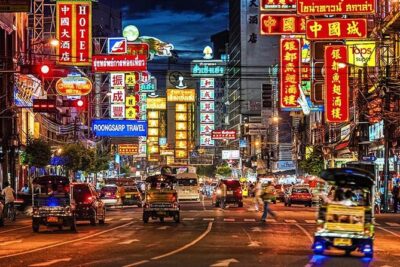
The vibe is part sightseeing, part treasure hunt. You get to wander in Chinatown where Chinese and Thai traditions show up in shrines, temple decorations, and everyday shopfronts. And because you start whenever you want, you can avoid stacking this with other timed activities.
If you like light problem-solving during travel, this can feel like a fun way to stay engaged. If you just want passive sightseeing, you might find yourself scanning more than soaking in.
Deeper into Yaowarat after dark
- Bangkok Authentic Tasting Thai-Chinatown Walking Food Tour
★ 4.9 · 852 reviews - Bangkok: Tuk Tuk Adventure Chinatown Michelin Food & Temples
★ 4.3 · 725 reviews - Bangkok Tuk-Tuk Tour by Night with Chinatown Street Food Meal
★ 5.0 · 635 reviews
Price and time, is it worth $6.99?

At $6.99 per person for about 1 hour 30 minutes, the main value is convenience. You are paying for a route, a puzzle structure, and phone-based guidance to a compact cluster of sights in Bangkok Chinatown.
What makes that price feel reasonable is that you can play at any hour, take breaks, and resume later. That flexibility matters in a city where heat, crowds, and traffic can change your plans fast. It also helps that the experience is permanently available, 24/7.
The other value is avoiding extra coordination. Since it is app-driven and avoids human contact, you spend less time meeting and more time moving. If you already enjoy exploring on your own, you are basically buying a designed walking path plus the story prompts.
How the Questo app quest works (and how not to get stuck)
The core mechanic is simple. You open the app, follow the on-screen directions to the next location, and answer each challenge by observing your surroundings. Each challenge then leads you onward, showing the next place and the next set of instructions.
Two practical points can make or break the experience:
Use your phone as the primary guide. One drawback to watch for is that some waypoints may not match perfectly with Google Maps. If you jump between apps, you can waste time and start doubting yourself.
Keep your phone powered. The quest is offline while you explore, but your battery still matters. If your screen runs low, the puzzle stops being fun and turns into a frustrating hunt.
Also, because you can start any hour and pause and resume, you can regroup if you lose your momentum. This is a good setup for travelers who want structure without feeling locked into a schedule.
Where you start and where you end

Your start point is Rong Muang, Pathum Wan, Bangkok 10330, Thailand. After you start, the app guides you step by step to the Wedding store, so you are not left guessing where the first clue begins.
The route ends at 586 ถ. เจริญกรุง Khwaeng Pom Prap, Khet Pom Prap Sattru Phai, Krung Thep Maha Nakhon 10100, Thailand. The design intent seems to be a Chinatown loop that hands you off near busy streets rather than bringing you back to your original exact starting corner.
If you plan to continue after the game, look at your next transport step in advance. You are finishing on a main road, which is helpful for public transportation, but it may still be lively around there.
More Bangkok days with a guide
Stop 1: Kan Kee Nam Tao Thong and the Chinese herbal drink clue
The quest begins near one of Chinatown’s long-running businesses. Many storefronts in this area are generations-old, and Kan Kee Nam Tao Thong is famous for Chinese herbal drinks made for a century+ of customers.
Your challenge here is all about looking. You need to scan your surroundings for the answer that advances you to the next location. This is a good first stop because it pushes you to notice the details you would otherwise walk past, like shop signage, small displays, and the kinds of products locals are actually coming for.
What I like about this start: it eases you into the puzzle. Instead of starting with a big temple where you might get distracted, you start with a human-scale business and a theme you can quickly understand.
Possible drawback: you will need patience. If you rush or keep moving before you read what the app asks, you can miss the clue and feel like you are “behind” right away. Take a slow lap, then commit to one direction.
Wat Traimit: the 5.5-ton Golden Buddha moment

One of the biggest stops is Wat Traimit, known for housing a seated Buddha made of gold. The statue is described as weighing 5.5 tonnes, dating back to the 13th century, and nearly 5 meters in height.
The temple sits in Chinatown, about 450 meters west of Hualampong Railway Station. For puzzle players, it also works well because it is a clear destination even when you are focused on the app.
Here, your job is again to look around to find the answer to the challenge. That means you are not just taking a quick glance at the gold Buddha and moving on. You are searching the space, reading context clues, and paying attention in a way that makes the temple feel more personal.
What makes this stop special: you get a major “wow” sight with a reason to slow down. You’re standing in front of something enormous and old, and the puzzle gives you a practical attention anchor.
What to watch for: crowds can happen around major attractions in Bangkok. Since this quest is app-only and you can move at your own pace, you can often wait a moment to search comfortably without feeling like you are holding up a group.
Eiah-Sae coffee shop: century-old atmosphere as part of the game
Between the temples, you also get a classic old-school shop stop: the Eiah-Sae coffee shop. It’s described as almost a century old, passed down through generations, and still known for a homey, noisy atmosphere.
This stop is likely where you’ll start to feel the quest shift from “temple focus” to “neighborhood life.” The route description also suggests you’ll sample local drinks and food at shops popular with locals, and this coffee stop fits that pattern.
Your task is, once again, to look around to find the challenge answer before you advance. This is a smart way to keep you engaged even if you are not in a museum mindset. You can slow down, grab a sip if you want, and still be progressing.
A practical tip: if you plan to buy something, do it early in the stop. You do not want to juggle a payment moment with a time-sensitive clue moment.
Possible drawback: coffee shops can be busy and loud. If you dislike noise, the “noisy atmosphere” detail matters. It is still part of the charm, just plan to focus on the puzzle rather than expecting a quiet break.
Wat Lokanukroh inside Sampeng Market
Wat Lokanukroh is described as one of the smallest temples in Bangkok. No monks live here, but people come to pray and offer ceremonies, even though it is located in the heart of Sampeng Market.
This stop is where you can see how Chinatown temple culture blends with everyday commerce. The market setting means you likely won’t feel like you are entering a separate world. It’s more like sacred space and shopping space share the same streets.
Like the others, your challenge is based on observation. You look around for the answer, then continue to the next part of the story.
Why it’s valuable: you get a different kind of temple experience than the big showcase sites. It is smaller, local, and still active with prayers and ceremonies. That gives your walk a more real neighborhood feel.
What to watch for: Sampeng Market areas can feel chaotic. If you get overwhelmed, use the app directions as your compass. Search with purpose, then move. Trying to roam randomly here can cost you time.
Leng Buai Ia Shrine from 1658 and what it meant for traders
Another highlight is Leng Buai Ia Shrine, an ancient Tae Chew shrine described as the oldest Chinese shrine in Thailand. It was built in 1658 during the Central Ayutthaya period, and it is tied to Chinese businessmen who sought refuge and prayed for prosperity for their businesses.
The shrine uses traditional Chinese architectural style, so you’re not just reading history on a plaque. You’re looking at a form that has been preserved and used.
This stop again uses the same puzzle framework. You look around to find the answer to advance and learn the story tied to the shrine.
What I like about it: the story connects faith to practical life, business, and survival in a trade-heavy area. Even if you are not religious, the context helps you understand why the shrine matters to the people who keep coming.
Possible drawback: this kind of shrine can be physically small and surrounded by other street elements. If you expect an open, airy space, it may not feel that way. Go slow and let the app prompt your attention.
Wat Leng Noei Yi, renamed by King Chulalongkorn
The final named temple stop includes Wat Leng Noei Yi, which opened as that name in the 1870s. It served as an introduction of Mahayana Buddhism in Bangkok, and later King Chulalongkorn renamed it to its current title.
The temple decor is described as heavy on motifs, including animal and floral patterns plus Chinese dragon motifs. The ordination hall is said to house a gold colored Buddha.
Your quest task remains the same style: look around for the challenge answer, then continue. The puzzle here is particularly useful because temples like this can be visually dense. The game nudges you to focus on specific details instead of getting lost in decoration.
Why this stop matters: you get both religious context and a visual “pattern reading” experience. Dragons, animals, and floral motifs are part of what makes Chinese temple art recognizable, and the story gives you a reason to notice them.
What to watch for: since the decorations are busy, you may need to slow down. Rushing can make the place feel confusing rather than interesting.
The Chinatown sights you’ll notice beyond the puzzle
Even though the game controls the order, you will still end up noticing things you would miss on a normal walking tour. This route is designed to lead you through places where Chinese and Thai beliefs and customs show up in real settings.
You’ll see how temples can be active without being a monk-only space, like Wat Lokanukroh, where people pray and offer ceremonies even though no monks live there. You’ll also see how shrines connect to community needs, as described for Leng Buai Ia Shrine.
And you’ll likely notice how old businesses stay alive in Chinatown. Kan Kee Nam Tao Thong and Eiah-Sae show how multi-generational places can still feel lively, not museum-still.
If you’re someone who likes to travel by observation, this quest style can scratch that itch while still giving you meaningful stops.
Practical tips to keep the app game fun
Here’s how I’d set yourself up for success.
Bring a charged phone. The quest is offline, which is great, but your screen time still depends on battery.
Expect to look around, not just scan. Each challenge pushes you to search your surroundings. Slow down at every stop for a proper look before you assume you missed something.
Trust the app steps more than Google Maps pins. If you’ve ever had a pin lead you a block away, you know the frustration. If the app directions disagree with Google Maps, follow the app for the best shot at staying on track.
Wear shoes that handle Bangkok sidewalks. The route passes through market and temple areas. You’ll be walking and stopping often.
If you’re in a group, coordinate like adults. One person can buy access for everybody by selecting the total number of people. Everyone plays on their own smartphones, so it helps if your group agrees on a pace and makes sure everyone has the app ready.
Who should book this self-guided mystery puzzle quest
This works best for you if you like:
- self-paced walking with a reason to pay attention
- light puzzle solving while traveling
- temple and Chinatown culture, with a side of neighborhood business life
- traveling in a way that avoids waiting for a guide or syncing schedules
It might feel like a chore if you want a sit-and-listen tour, or if you get stressed by wayfinding that depends on app instructions. It can also be tiring if you’re rushing through Chinatown without the patience to look for details.
Because it is described as most travelers can participate and service animals are allowed, it is broadly suitable. Just remember that it is still an outdoor street walk through active areas.
Should you book it?
If you like puzzles and you want a structured way to explore Chinatown without locking into a guide schedule, I think this is a good buy for the money. The offline support, flexible start times, and compact route make it easy to fit into a day.
Book it if you’re curious about Wat Traimit and the smaller shrines nearby, and if you’re happy to spend some time scanning the environment. Skip it if you strongly prefer straightforward navigation or if you know you will hate searching for clues on foot.
Either way, keep one mindset: the goal here is to move, look, and figure it out step by step. When you do that, the temples and old shops stop being just locations and start feeling like part of the story.
FAQ
How long does the Bangkok Chinatown puzzle quest take?
It lasts about 1 hour 30 minutes.
How much does it cost?
The price is $6.99 per person.
Do I need internet to play?
No. You can play offline while exploring, so you do not need an internet connection.
Is there a physical guide with you?
No. There is no physical tour guide. You follow the steps in the Questo app on your own phone.
Can I start at any time and take breaks?
Yes. You have full flexibility to start at any hour, take a break at any time, and resume later.
What is the starting point?
The start is Rong Muang, Pathum Wan, Bangkok 10330, Thailand. The app guides you step by step to the Wedding store.
What is the cancellation policy?
You can cancel for free. You can cancel up to 24 hours in advance for a full refund, and cancellations within 24 hours are not refunded.
Smoother With a Guide
More Tour Reviews in Bangkok
Deeper Into Yaowarat
Just In: Fresh Bangkok Reviews
Chinatown Tours, compared.
★ 4.9Bangkok Authentic Tasting Thai-Chinatown Walking Food TourFrom $43852 reviews
★ 4.3Tuk Tuk Adventure Chinatown Michelin Food & TemplesFrom $18725 reviews
★ 5.0Bangkok Tuk-Tuk Tour by Night with Chinatown Street Food MealFrom $40635 reviews
★ 5.0Bangkok by Night Food Tour with 10+ Tastings in ChinatownFrom $46545 reviews
★ 4.6Bangkok Tuk-Tuk by Night with Chinatown Street Food MealFrom $40263 reviews
★ 4.8Chinatown Food Tour with Michelin Food StallsFrom $36226 reviews
★ 5.0Bangkok Night Michelin Foodie Tour in Chinatown with 15+ tastingsFrom $56189 reviews
★ 5.0Night Street Food Tour of Bangkok’s ChinatownFrom $58173 reviews
Browse the lists this tour appears in